Independent report aims for a safer, stronger future for counselling and psychotherapy
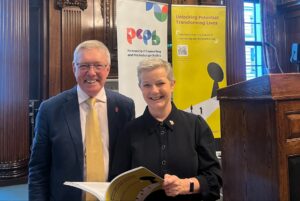
Commission co-chairs Andrea Sutcliffe and Phil Hope at the launch of the report.
The independent Commission for the Future of Counselling and Psychotherapy has published its landmark report, setting out a vision for a profession that is safer, stronger and better equipped to meet the UK’s growing mental health needs.
Established by the Partnership of Counselling and Psychotherapy Bodies (PCPB), the independent Commission was asked to examine the current and emerging issues facing the profession and the barriers that affect people’s access to therapy. Its work brought together perspectives from across all four nations of the UK, drawing on evidence from more than 4,000 practitioners, employers, commissioners, researchers and people with lived experience.
An executive summary of the report is also available.
A profession with the potential to do more
The Commission heard that around 14 million people across the UK are estimated to be experiencing mental health problems, while many struggle to access timely support. At the same time, the Commission found substantial, unused capacity within an existing workforce of around 82,000 qualified counsellors and psychotherapists on Professional Standards Authority (PSA) accredited registers.
As part of the evidence presented, practitioners represented across the six PCPB partners reported capacity to provide an additional 370,000 therapy hours each week. The report estimates that using just 10% of this spare capacity could enable more than 150,000 additional people to receive therapy each year, at a cost equivalent to 0.56% of the UK mental health budget.
The report highlights that closing the treatment gap is not only about training more practitioners or securing additional investment. It also requires a coherent, long-term approach to commissioning, workforce planning, professional development, regulation, evaluation and deployment. Better use of counselling and psychotherapy can support earlier intervention, widen access in neighbourhood and community settings, and help prevent difficulties from escalating, the report says.
Phil Hope, independent co-chair of the Commission said: “The UK faces growing demand for mental health support, yet this report shows we already have a highly skilled workforce with significant untapped capacity. Making better use of the workforce we already have could help more than 150,000 additional people access timely support without waiting for long-term workforce expansion.”
The report organises its recommendations around six connected strategic priorities:
1. Improve commissioning and funding
Increase access to evidence-based counselling and psychotherapy across the health, education, workplace and community settings.
2. Strengthen public protection
Introduce statutory regulation and strengthened professional standards.
3. Build a sustainable and diverse workforce
Improve education, training, workforce development and diversity.
4. Strengthen the evidence base
Increase research and evaluation and ensure evidence is better reflected in commissioning and policymaking.
5. Raise public and political recognition
Increase awareness of the contribution counselling and psychotherapy can make to mental health and wellbeing.
6. Give the profession a stronger collective voice
Create a Counselling and Psychotherapy Federation to improve co-ordination and influence.
Each priority is backed by practical recommendations, including actions tailored to the different policy and service contexts of England, Scotland, Wales and Northern Ireland.
Andrea Sutcliffe, independent co-chair of the Commission, said: “The Commission makes a clear case for seeing counselling and psychotherapy as a core component of the UK’s mental health infrastructure – backed by the funding, workforce planning, regulation and evidence needed to realise their full potential.”
From recommendations to action
Publication of the report is not the end of the work, it’s the beginning of the next phase.
Turning this roadmap into meaningful change will depend on continued collaboration between professional bodies, governments, policymakers, commissioners, employers, researchers, practitioners and people who use mental health / therapeutic services.
The PCPB will work with partners across the sector to build on the report’s evidence, develop the recommendations and support a more strategic approach to how the counselling and psychotherapy workforce is commissioned, valued and integrated within services. The profession also has an essential role: continuing to raise standards, improve diversity, demonstrate impact and speak with a stronger collective voice.
Professor Adam Boddison OBE, independent chair of the PCPB, said: “This report should be a catalyst for change and greater collaboration. We are committed to working with governments, policymakers and partners across the sector to turn these recommendations into action.”
